Since our last newsletter, Xinachtli’s health has taken a sharp downturn: He has experienced frequent falls—including one which caused a major head injury, progressive numbness in his limbs, bladder incontinence, repeated UTIs, rapid weight loss and severe mobility loss, to the point where he now requires a wheelchair and walker to get around.
Throughout this time, the Texas Department of Criminal Justice has subjected Xinachtli to illegal and barbaric conditions that violate his fundamental human rights. Unfortunately, far from being extraordinary, these conditions are all too common for prisoners in the so-called United State, particularly political prisoners, and especially elderly political prisoners, who the state would like nothing more than to disappear and kill.
During his transfer to the McConnell Unit’s infirmary, the guards threw away all of Xinachtli’s belongings and “lost” his commissary card, leaving him with no access to hygiene items, food, and other basic necessities. They also purposefully denied him several forms he needed in order to access his medical records and visitation rights.
Yet we know that Xinachtli’s death is not inevitable. After a weeks-long phone zap to put pressure on the McConnell Unit where Xinachtli had been held captive, the Xinachtli Freedom Campaign has won several of his demands! Xinachtli has now been transferred to a TDCJ hospital in Galveston and received access to his medical records.
But the fight to free Xinachtli is not over, and we need your help to keep up the pressure. He has now been forced to spend three decades of his extraordinary life in horrific, inhumane conditions due to his revolutionary beliefs and actions. His life has been marked by a steadfast dedication to organizing, an insistence on Chicano Indigenous power, and an unwavering commitment to justice.
Like many of his peers, Xinachtli’s unjust conviction is now turning into a de facto death sentence—a slow killing. The fascist state is scared of what this revolutionary elder can do. The extreme medical neglect, torture, and abuse that Xinachtli is just one example of the all too common violence that the settler state enacts against revolutionary elders.
For decades, we have mourned the deaths of political leaders who taught us what solidarity and revolutionary change can look like, from Ricardo Romero, Sekou Odinga (who was released from prison after 33 years behind bars, before ultimately passing away in 2024 at the age of 79), and most recently, Imam Jamil Al-Amin, who died behind bars at the age of 82 after battling multiple myeloma cancer, including a palm-sized facial tumor.
Make no mistake: Al-Amin was murdered by the Amerikkkan prison system’s extreme medical neglect, intentional delays in treatment, and repeated holding of Al-Amin in solitary confinement, which significantly worsened his condition. Still, throughout his years of imprisonment, he never gave up his revolutionary principles, maintaining his principled struggle against imperialism from within the belly of the beast
Today, many elderly resistance fighters remain unjustly held behind bars—from Oso Blanco to Joy Powell, Shukri Abu Baker and Ghassan Elashi, to Kamau Sadiki, Mumia Abu-Jamal, Abdul Malik Ka’bah, the Virgin Island Three and Shaka Shakur. Most of these revolutionary prisoners are serving de facto life sentences. In other words, they have been sentenced to death by incarceration for resisting colonial and imperial power and rebelling against this racist, inhumane, and unjust system.
Too often, our movements wait to honor their stories and sacrifices until after they have passed. Revolutionaries continue to be unjustly held captive by the state, and it is up to us to not only uplift their voices and continue their protracted struggle for freedom, but to refuse to let their history be buried or erased. We cannot wait until they have died. We can not allow them to wither away behind bars, alone and forgotten.
In an article published in September 2023, Abu-Jamal, who was captured in 1981 and sentenced to life without parole, described the inhumane conditions affecting elderly political prisoners in a piece titled “No Place for Old Men”:
“One of the vagaries of mass incarceration is the explosion of the elderly as part of the prison population. Today, men in their seventies and eighties roll around here in wheelchairs or hobble on walkers or even stroll with the help of canes. They have a host of health problems from diabetes, which is quite prevalent, [Chronic Obstructive Pulmonary Disease] COPD, from heart attacks and ailments to cancer.
The American Public Health Association has advanced the novel idea that the elderly in prisons have been subjected to ‘elder abuse’ by the state in all the ways they have been mistreated and maltreated, for they are subjected to solitary confinement, to aching joints, to the natural frailties of old age. APHA has urged that elderly prisoners be made free of ‘elder abuse’ by release from confinement. They have urged this upon state, county, federal and territorial prisons, jails and institutions of detention.”
Over the past several years, Abu-Jamal’s eyesight has severely deteriorated due to complications from diabetic retinopathy and a failed cataract surgery in 2019
Yet prisons continue their attempts to break the spirits of our revolutionary elders in order to undermine our movements. Their continued captivity, suffering, and death behind bars is a deliberate attempt to sever them from their communities and prevent them from passing on their vast knowledge, wisdom, and lessons to the next generation of revolutionaries.
After a recent visit with Xinachtli, the choice was clear: Either he walks free now, or we watch another revolutionary be murdered behind bars. The McConnell Unit reeks of injustice and inhumanity. Sadness and anger fills each room, yet Xinachtli continues to greet everyone with a smile, leading his freedom campaign with revolutionary hope and love. He is asking us to call on international, national, and local groups to support his immediate release, and reminds us not to be discouraged—that the fascist government is simply scared of what the people are capable of when we are united and determined to win.
The struggle against U.S.-led imperialism and colonialism is only alive today because of the immense sacrifice of the people who came before us—including Xinachtli. Thus, the fight to tear down the walls of the Amerikkkan prison system is central to that struggle. As George Jackson once said: “We must abolish the function of the prison as a concentration camp.” By this, he meant that the function of the prison in Amerikkka is to destroy the potential for revolution, which is why the struggle to free our prisoners must be at the heart of any revolutionary movement.
Please show your support for Xinachtli by signing this letter to show the criminal legal system that their inhumane treatment of Xinachtli will not go without consequence.
Our Demands:
- Transfer to a geriatric and medical unit that is fully accessible under the Americans with Disabilities Act. Xinachtli requests placement at the Richard P LeBlanc Unit in Beaumont, Texas.
- Approval of Medically Recommended Intensive Supervision, the release program for individuals with serious medical conditions and disabilities.
We demand better for all our political prisoners, the leaders of our revolutionary movements. We refuse to let our revolutionary elder Xinachtli die by incarceration. We want to see him home, we want to see him free—by any means necessary. Freedom is the only treatment.
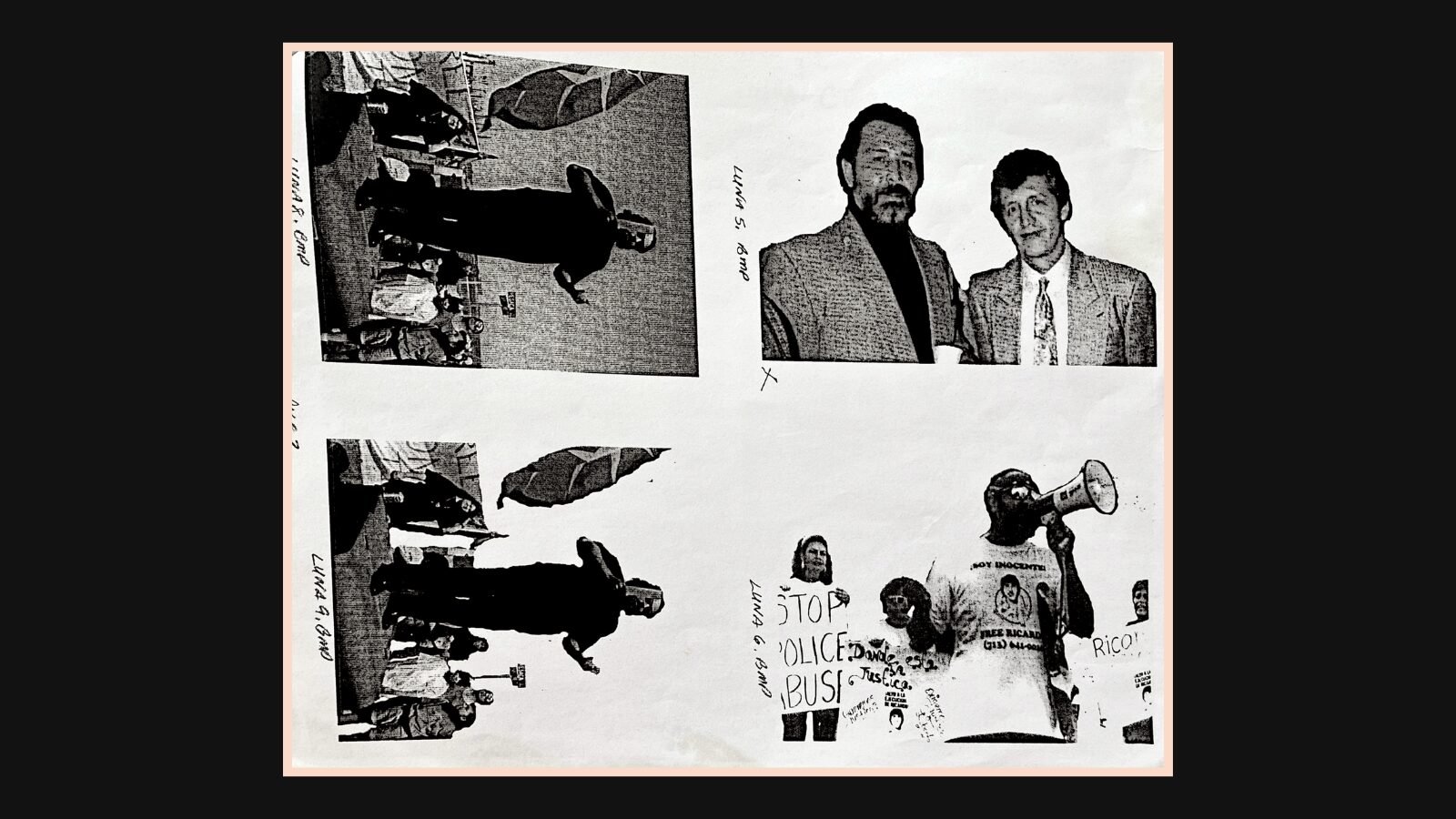
Photo: Bottom right: X speaks at a 1995/96 protest against the wrongful incarceration of Ricardo Aldape Guerra, who spent 16 years in Texas prisons, many of them on death row, where he had been framed for the murder of a Houston cop. X was the national coordinator of the Ricardo Aldape Guerra Defense Committee, which led to Guerra’s eventual freedom in 1996.